



-
admin
- July 8, 2025
Most agency delays don’t start in the design file or the dev sprint. They start somewhere far less glamorous: a sluggish staging server nobody thought to question.
You’ve probably seen the version of this that nobody puts in the case study. The client wants an update before lunch. The designer is waiting on a preview link that still hasn’t loaded properly. The developer is waist-deep in some server-side issue that shouldn’t exist in the first place. Meanwhile, the paid campaign tied to the landing page is supposed to go live tomorrow, and everyone is suddenly speaking in that strained “just circling back” tone that means things are already late.
This gets blamed on communication, scope creep, bad clients, junior staff—take your pick. Sometimes those things are true. More often, the delay is more boring than that. The hosting setup is slow, fragile, or stitched together with just enough compromise to become a problem at the worst possible moment.
Agencies like to treat hosting as plumbing. Something necessary, mildly annoying, and best ignored until it leaks. That’s a mistake. Hosting touches almost every part of delivery, whether the client ever thinks about it or not. If your infrastructure is smoother, projects move faster. Fewer surprises. Fewer panicked Slack messages. Fewer awkward calls where you explain why the “final review link” is still loading. This is how better hosting quietly makes agencies look more competent than they otherwise might deserve.
Hosting affects more of your agency workflow than you think
Most agencies think about hosting at the end.
That’s backwards.
Hosting isn’t just where a website sits after launch. It affects:
- how quickly your team can spin up environments
- how smooth client review rounds feel
- how safely you can test changes
- how stressful launches become
- how much time your team wastes fixing things that were never really creative problems to begin with
A slow staging site doesn’t just feel annoying. It drags out approvals. A flaky server doesn’t just cause downtime. It turns simple revisions into risk. A weak backup system doesn’t just feel inconvenient. It means every big edit comes with a low-grade fear that someone’s about to break production.
How fast you deliver often depends on systems clients never see.
That’s the frustrating part. Infrastructure is invisible when it works. Which is why people keep underestimating it.
The small hosting problems that quietly waste agency time
Bad hosting rarely creates one giant disaster. It’s usually death by a hundred small delays.
Things like:
- staging links that load slowly enough to disrupt feedback
- SSL certificates taking forever to provision
- DNS changes that feel like a hostage negotiation
- plugin conflicts because the server stack is outdated
- migrations that somehow become two-day projects
- backups that take so long nobody wants to risk restoring
None of this sounds dramatic on paper. It becomes dramatic when it compounds.
A landing page misses an ad launch window because the preview wasn’t approved in time. An ecommerce store buckles right before a client’s sale. A migration overruns by three days and suddenly your “premium process” looks suspiciously like improvisation.
This is what bad hosting really does: it adds friction where there should be momentum.
What actually helps agencies move faster
This is the part people tend to oversimplify.
Better hosting doesn’t magically make your team more talented. It just removes the dumb obstacles that slow down talented people.
That’s often enough.
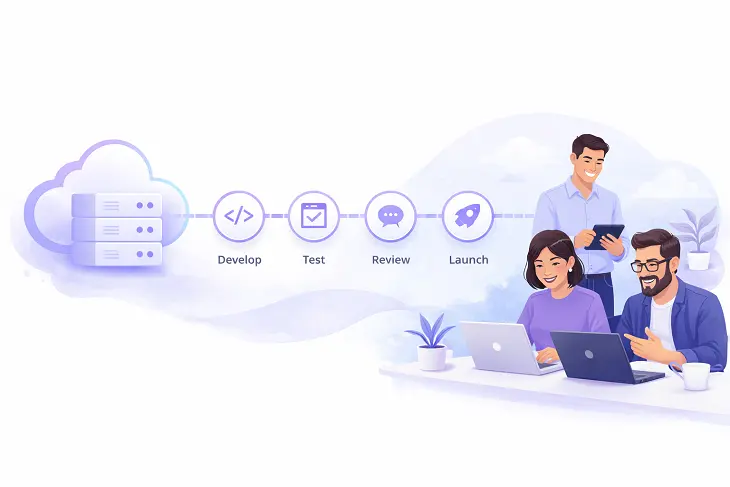
1. Faster staging and development workflows
This matters more than most agencies admit.
A good staging setup means:
- one-click site clones
- sandbox environments for testing
- easy rollbacks
- fast deploys
What this means in practice:
- developers can test without risking live sites
- designers can review changes properly
- clients can approve faster without broken previews
Less time fixing. More time shipping.
That sounds obvious until you’ve watched someone manually duplicate a WordPress site at 11 p.m. because the host doesn’t support staging.
2. Speed clients can actually feel
Clients may not understand TTFB or caching layers. They absolutely notice when a preview link feels slow.
And they make judgments fast.
A slow link makes work feel unfinished, even if the design is solid. A fast site feels polished. More trustworthy. More “ready.”
Things that matter here:
- strong server response times
- CDN support
- optimized asset delivery
- modern storage like NVMe
A fast preview link builds confidence before the client even reads your explanation.
That matters more than most pitch decks.
3. Hosting that doesn’t make teamwork harder
Agency work is already messy enough.
You’ve got:
- designers
- developers
- copywriters
- media buyers
- project managers
All touching the same project in different ways.
Bad hosting turns this into chaos fast.
Look for:
- role-based access controls
- Git support
- SFTP access
- sensible permission settings
This isn’t about fancy tooling for its own sake. It’s about smoother handoffs. Fewer bottlenecks. Less time asking, “Who changed this?”
4. Better uptime means fewer surprise disasters
A lot of agency stress comes from things breaking at inconvenient times.
Which, to be fair, is usually when things break.
Reliable hosting means:
- fewer site outages
- fewer client complaints
- fewer emergency fixes
- fewer ruined weekends
This is what good infrastructure buys you more than anything: mental bandwidth.
The less time your team spends firefighting, the more time they have to do the work clients are actually paying for.
5. Easier launches and migrations
This is where hosting can make an agency feel either slick or deeply unprepared.
Launches are stressful enough without:
- DNS delays
- SSL issues
- propagation confusion
- broken redirects
Good hosting should make this boring.
You want:
- simple domain pointing
- quick SSL provisioning
- launch support if something goes sideways
A smooth launch makes you look calm. Clients remember that.
Mostly because they’ve worked with enough people who weren’t.
6. Backups that let you work without fear
Every agency says they have backups. Fewer have backups they trust.
That’s different.
What you need:
- daily automatic backups
- instant restore points
- version rollback options
This matters during:
- redesigns
- plugin updates
- content changes
- late-stage client “small tweaks” that are somehow never small
Good backups remove hesitation. That alone can make delivery faster.
7. Support that feels like actual support
This one gets ignored until the exact moment it becomes the only thing that matters.
Agencies need support that:
- answers quickly
- understands technical problems
- can help with migrations and launch issues
Not:
- copy-pasted scripts
- three-hour delays
- vague promises to escalate
Because when a client site breaks on a Friday night, your host is either part of the solution or part of the reason your weekend is gone.
The hosting mistakes agencies keep making anyway
Some of this comes down to habit. Some of it is just false economy.
Common mistakes:
- choosing the cheapest reseller plan available
- packing too many clients onto one weak server
- using clunky white-label systems
- skipping staging entirely
- tolerating slow support because switching feels annoying
Cheap hosting often becomes expensive in lost time.
Not all at once. Just slowly enough that people don’t notice until the margins are already gone.
Clients notice the effects, even if they never mention hosting
Clients don’t usually care what stack you’re using.
They care that:
- review links work quickly
- launches happen on time
- changes don’t break things
- campaigns go live smoothly
That’s what they remember.
Better hosting improves:
- confidence during review rounds
- perceived professionalism
- trust in your process
Clients may never ask what server you’re on. They will absolutely notice friction.
Usually right before asking for a discount.
Match hosting to the kind of agency you run
Different agencies need different setups.
Web design agency
Usually:
- managed WordPress
- VPS if you manage multiple builds
Performance marketing agency
Prioritize:
- fast landing page hosting
- CDN support
- traffic resilience
Full-service agency
Best fit:
- VPS or managed cloud
You need flexibility and cleaner collaboration.
Ecommerce agency
Use:
- scalable managed cloud
Because “the site went down during the sale” is the kind of sentence clients tend to remember.
Signs your hosting is slowing you down already
Watch for:
- staging environments that feel sluggish
- clients mentioning site lag
- backups taking forever
- launches feeling unnecessarily tense
- support that’s more ceremonial than useful
If every launch feels harder than it should, your hosting may be part of the problem.
Not the whole problem. But probably enough of it.
A faster agency is usually a better system, not just better people
The agencies clients love working with aren’t always the most creative. Often, they’re just smoother.
They move quickly. They make launches feel calm. They don’t turn simple changes into week-long sagas.
That kind of delivery usually comes down to systems more than talent.
Better hosting is not just where a client site lives. It’s part of how fast your agency can move.
The right setup won’t make you brilliant. It will quietly remove the delays that keep good work from looking as good as it should.